
How it Started
Making a difference in Africa, Village Industrial Power Inc
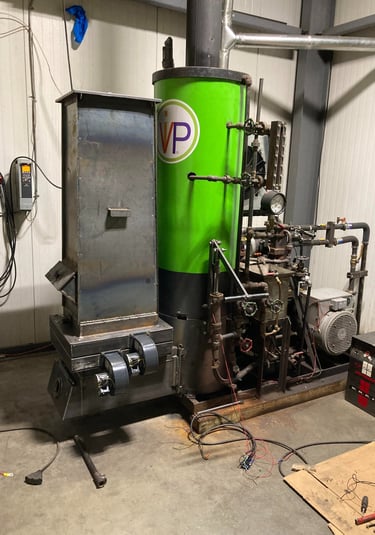
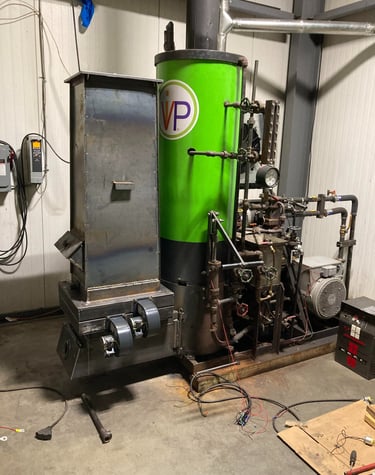
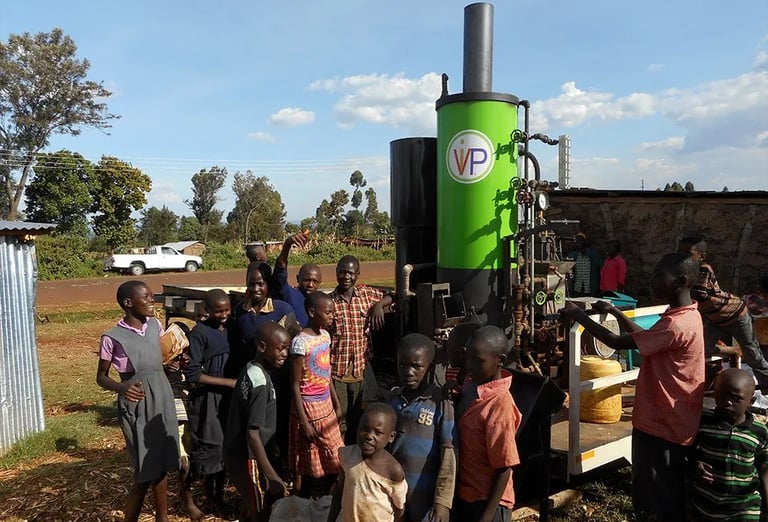
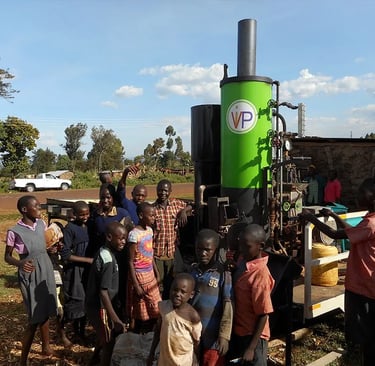
Carl Bielenberg, founder, CEO/CTO of Arboreal Energy Systems started his vision through Village Industrial Power (VIP) is a social enterprise commercializing clean energy solutions for rural communities and industries in Africa— such as tea estates and fruit growers — with 10 years of CHP engineering and deployment experience in Africa. His VIP10-40 flagship product is a Combined Heat and Power Plant (the "10-40"), which provides on-demand thermal, electrical, and mechanical energy using agricultural waste as fuel, for uses ranging from crop processing to providing power and hot water in remote, off-grid areas. In this setting his technology enabled rural farmers to increase the value of their crops by >10x by transforming raw agricultural produce into value-added products. VIP retains its international mission and operations as a wholly independent entity from Arboreal Energy Systems.
The Evolution of Wood-Burning Steam Technology
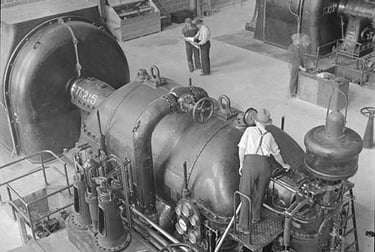
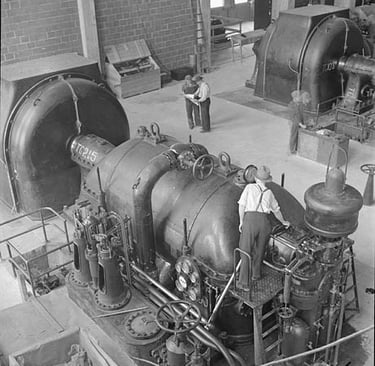
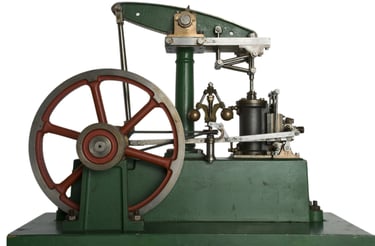
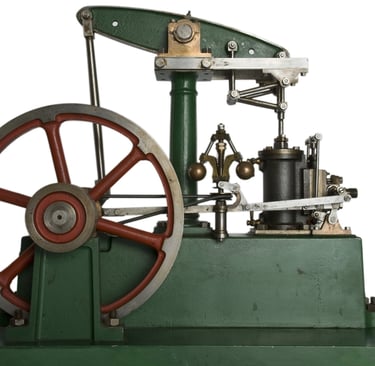
In the past 200 years, wood-burning steam engines have transformed from simple "kettle-style" boilers into highly sophisticated, automated systems. Early 19th Century boilers were essentially large iron tanks ("kettle-type") placed directly over a wood fire. They were extremely inefficient, often losing over 95% of the fuel's energy. By the late 19th to Mid-20th Century wood-burning engines transitioned to multi-tube boilers, which passed hot gases through tubes surrounded by water to increase the heating surface, increasing thermal efficiencies between 50% and 70%. Advances in modern Combined Heat and Power (CHP) steam engine systems including staged combustion fireboxes, varying boiler pressures, improvements in waste heat recovery, have raised efficiencies to 80%-90%, and have eliminated almost all smoke emissions.
The problem has been all of these developments have centered around industrial applications for steam power, primarily centralized power generation. To fuel these industrial steam engines, wood was largely abandoned by the early 20th century, replaced by coal, natural gas, oil and nuclear fuels for large-scale stationary power generation. However, wood-burning technology has survived and evolved to regain its rightful place as the ideal sustainable energy for the 21st century and beyond.
The only residential-scale wood fueled steam CHP generator in North America.
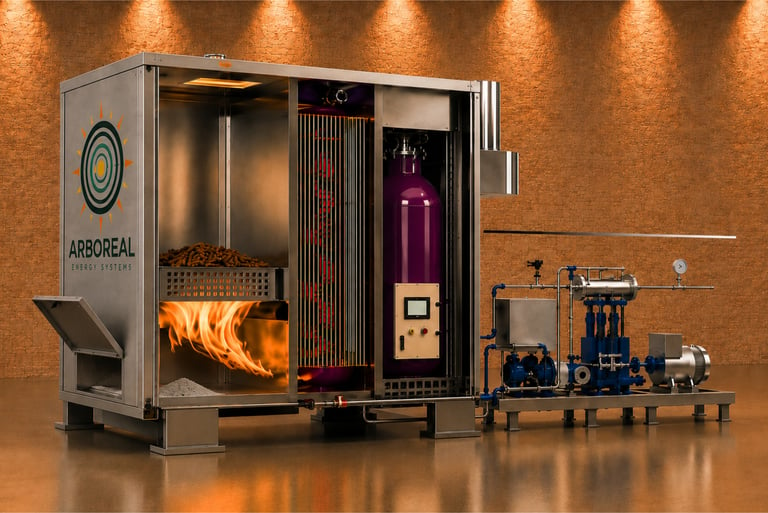
The Arboreal CHP system is a residential scale, modular, automated, wood-chip-fueled, steam driven, combined heat and power platform. It is designed as a heat-first appliance: the primary output is space and water heating, with electricity generated as a valuable co-product of the thermal process. This design philosophy is deliberate — it aligns product performance with cold-climate customer needs, avoids the inefficiency of electricity-only generation, and positions the system within established residential biomass heating regulatory frameworks.
System Configuration
The base platform follows a staged thermal-to-mechanical-to-electrical conversion pathway:
• Automated fuel feed: Wood chips are loaded into a storage hopper and conveyed by auger to the combustion chamber on demand.
• Staged combustion chamber: High-temperature primary and secondary combustion zones ensure complete fuel oxidation, minimizing particulate emissions to target EPA Step 2 limits (2.0 g/hr PM).
• Heat exchanger and steam generation: Combustion gases transfer energy to a pressurized water loop, producing steam or high-pressure hot water.
• Power conversion: Steam or hot gas drives a small-displacement engine/turbine connected to a generator, producing up to 10 kW of AC power per module.
• Heat recovery: Exhaust thermal energy is captured for space heating and domestic hot water, achieving overall system efficiency of approximately 80%.
• Grid interface: An inverter and automatic transfer switch enable grid-tied operation with seamless islanding during outages.
• Controls: An integrated PLC with remote monitoring manages combustion, fuel feed, safety interlocks, and performance logging.
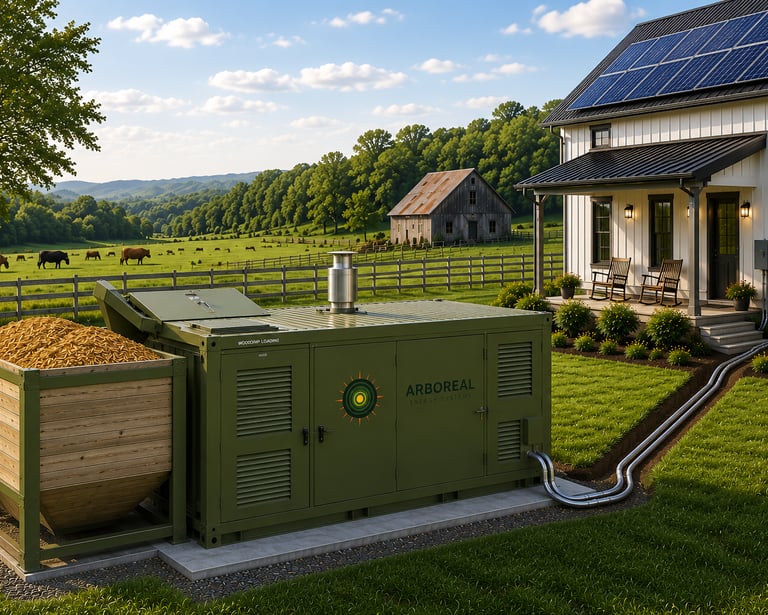

Carbon neutrality is central to the sustainability of wood-fired cogeneration and other biomass energy systems. It means the CO2 released from burning biomass (wood chips) is balanced by the CO2 absorbed as that biomass grows (Trees).
In wood-fired cogeneration, biomass such as wood is considered renewable because its carbon is part of the natural carbon cycle. When burned, it releases recently absorbed carbon rather than adding fossil carbon to the atmosphere.
Key factors that support carbon neutrality include:
Biomass growth: Plants absorb CO2 through photosynthesis and store it as carbon in the form of cellulose and ligand in trees.
Combustion: Burning biomass releases that stored carbon back into the atmosphere as CO2.
Fossil fuel displacement: Biomass can reduce reliance on coal, oil, or natural gas, avoiding additional fossil-carbon emissions.
Carbon sequestration: Sustainable forestry and replanting help maintain the carbon balance over time.
Overall, wood-fired cogeneration can support lower-carbon energy production when trees are sourced and managed sustainably.
The Carbon Neutral Solution
