
The only residential-scale wood fueled CHP in North America.
Arboreal Energy Systems is raising an angel round to complete R&D validation, achieve EPA and UL certifications, and deploy three beta installations — the milestones that de-risk a Series A in a $6.5B and growing market with no direct residential-scale competitors
Market opportunity
Global micro-CHP market to reach $6.5B by 2029, Growing at 11.3% CAGR · Allied Market Research 2024
Total Addressable Market (TAM)
40–45M units
Cold-climate residential & farm
North American residential units with high heating costs and wood resource access
Serviceable Obtainable Market (SOM)
~850–1,000 (5 yrs)
Phase 1 target geography
ME, VT, NH, MI, WA,OR — accessible via Solar installer network and USDA REAP-qualified farms
Serviceable Available Market (SAM)
3.5–5M units
Off-gas, high-electricity-cost rural
Rural northeastern US without natural gas, on propane/oil, >$0.16/kWh electricity
$50,000 Average selling price
Single 10 kW installed unit, $40,000 hardware + $10,000 installation
500 Units Year 5 installation target
$25M hardware revenue
3.5 yr Customer payback period
2.8–3.5 yr with USDA REAP 50%
$8–10K Annual customer Energy savings estimate
Electricity + propane displacement · northeastern US
Year Units sold HW Revenue Gross margin 40%
Yr1 5 $250,000.00 $100,000.00
Yr2 20 $1,000,000.00 $400,000.00
Yr3 75 $3,750,000.00 $1,500,000.00
Yr4 250 $12,500,000.00 $5,000,000.00
Yr5 500 $25,000,000.00 $10,000,000.00
installed system revenue — 10 kW modular units ONLY
02 — Technology risk retired before first US dollar invested
The combustion architecture, dual-boiler thermal integration, and steam-cycle performance were developed and field-validated by Village Industrial Power (VIP) over eight years of off-grid deployment in Kenya. Three categories of risk — combustion performance, thermal efficiency, and off-grid reliability — are retired before the angel raise. US investment funds commercialization, certification, and market entry, not fundamental R&D.
03 — A market primed for disruption
Propane and heating oil prices are volatile and trending upward. Grid reliability in rural northeastern US is declining. Solar penetration among Arboreal's target customers is high but incomplete without dispatchable backup. The customer pain is acute, the alternatives are inadequate, and the fuel supply chain (locally sourced wood chips) has been price-stable for over a decade.
04 — Clean IP with a defensible technical moat
All US-targeted platform IP is being formally assigned to Arboreal Energy Systems prior to the angel close. The dual-boiler thermal architecture, below-grate draft combustion configuration, and closed-loop steam-cycle design represent 8 years of engineering refinement that a competitor would need years to replicate — even if they chose to enter the same market, which the gasification players structurally cannot.
06 — The most energy-efficient heating and power system available at residential scale
At ~80% overall efficiency (thermal + electrical, HHV basis), the Arboreal CHP extracts nearly four times more useful energy per ton of fuel than a wood stove and displaces both a heating oil boiler and a grid electricity connection simultaneously. No competing residential product — heat pump, diesel generator, solar array, or pellet boiler — approaches this combination of heat output, electrical output, island-mode capability, and fuel cost stability.
Investment thesis
Six reasons this is the right company at the right time.
05 — Government funding that subsidizes customer acquisition
USDA REAP grants cover up to 50% of installed cost for farm and rural small business customers. At $55,500 total installed cost, a 50% REAP grant cuts customer net outlay to $27,750 — reducing simple payback to under 3 years. This is not a speculative future incentive. It is a $2B+ program with active funding through 2027, currently accepting applications.
01 — A market gap that is structural
Wood gasification — the only competing technology for biomass CHP — cannot scale below ~30 kWe economically due to the cost floor of reformers, gas cleaning trains, and controls. Spanner Re2, the world leader with 700+ global installations, has been attempting US residential market entry since 2018 with USDA funding and has not succeeded. The barrier is inherent to their technology. Arboreal's direct-combustion steam cycle faces no such constraint.
01 — Hardware sales (10/20/40 kW modular units)
$40,000 hardware ASP per 10 kW module. Gross margin target 38–42% at volume. Each unit sale is installation-independent — Arboreal sells the hardware; certified AES installers perform installation. Revenue recognized at hardware delivery.
02 — Annual service & monitoring subscription
Remote monitoring platform subscription ($240/yr) plus optional annual service contract ($600/yr). Platform-level data from all operating units feeds product improvement and enables predictive maintenance alerts — a network effect that grows in value with each installation.
04 — Wood chip fuel partnerships (Year 2+)
Revenue-sharing agreements with regional logging and land-clearing operations for delivered, moisture-tested chips to Arboreal customers. Logistics partner handles last-mile delivery; Arboreal earns a referral fee and ensures fuel quality standards. Validated model — both Maine Energy Systems and Commercial Bioenergy operate fuel supply as a profitable standalone line.
03 — USDA REAP grant facilitation (Year 1+)
Arboreal includes REAP pre-qualification support in the farm customer sales process. This reduces price sensitivity by up to 50% for qualifying customers and differentiates from any future competitor. Potential future grant facilitation fee of $500–1,500 per successful application as service scales.
Business model
Hardware today. Recurring revenue from day one.
$40K ASP · 38–42% GM target
$840/yr/CUSTOMER· 90%+ gross margin
5–8% margin on ~$3,500/yr customer spend
Customer acquisition accelerant
05 — Existing Solar Distribution Network
An Arboreal distribution partnership converts existing Solar installer network into Arboreal's salesforce and their existing customers into Arboreal upgrade prospects.
>6 million existing Solar installations Customers
Instrument - SAFE (Simple Agreement for Future Equity)
Discount rate - -20% to Series A
Valuation cap - $10M pre-money cap
Pro-rata rights - Yes
Min. Investment size - $50,000
Target close - Q4 2026
Converts at Series A (qualified financing ≥$1M); milestones targeted before raise: EPA cert + 3 betas
Top Angels Bonus Offer!
The first 3 largest investing Angels will receive one of the Beta CHP units if they qualify and agree to participate in the UL/EPA certification and marketing data collection program.
Angel Round Investment
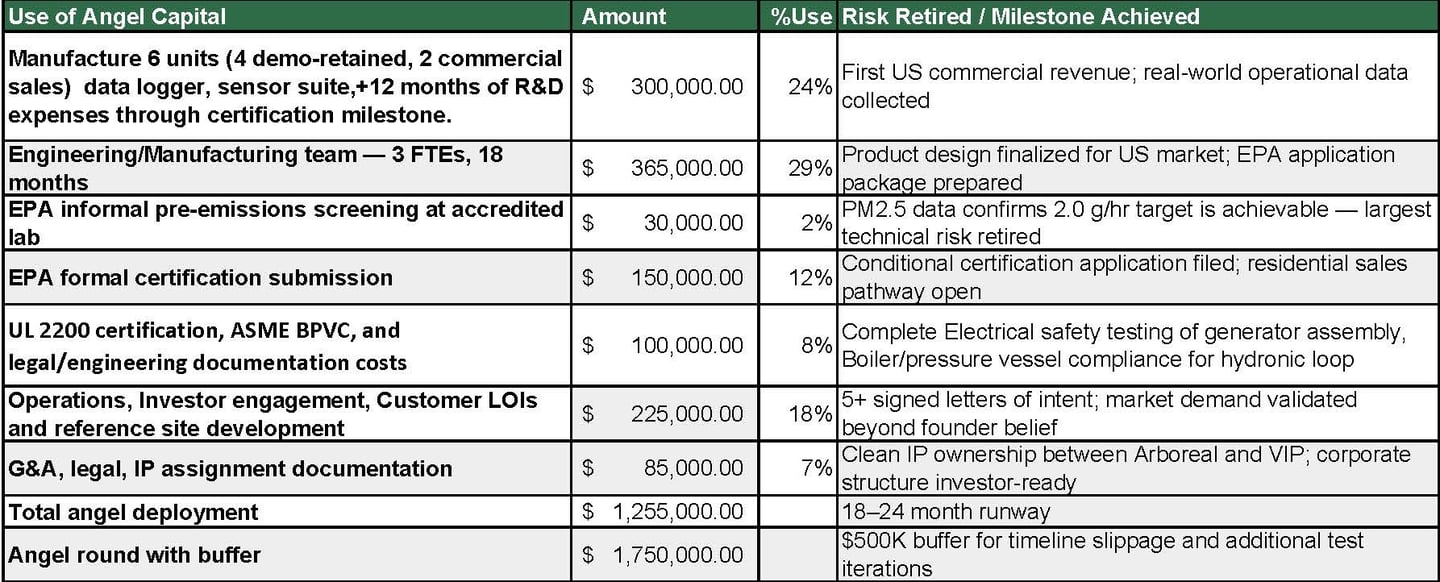
From proven technology to certified product. The angel round funds the specific milestones that convert the validated CHP technology into a US-certified, retail customer-deliverable product — and de-risk the Series A.
$1.75M Angel round target raise
Use of Funds